Software-Defined WAN
SD-WAN uses software and cloud-based functions to deliver internet connectivity simply, quickly, at good quality and securely.

Software-defined WAN, or SD-WAN, uses software and cloud-based functions to deliver internet connectivity simply, quickly, at good quality and securely. Companies with distributed branch offices gain agility from it, and save money.
Overview
Enterprise networks are changing. Driven by everything virtualisation and cloud computing brought with them, the enterprise network, which had gone largely unchanged, is now at the centre of that change.
Mobile devices and new applications regularly push traditional networks built on legacy technology to their limits. SD-WAN answers that as a software solution on commodity hardware: a technology that decouples from the hardware and can keep pace with what happens in enterprise IT.
SD-WAN is the logical next step after SDN (software-defined networking). Thanks to SDN, the advantages of virtual networks are no longer tied to a data centre. This new SDN solution now helps companies improve how their branch offices connect, and make that connection cheaper.
Why SD-WAN is needed
- Cloud-based applications raise MPLS bandwidth requirements, which costs a lot
- Connecting branch offices is complex
- Traditional WAN architecture makes migrating to hybrid and public cloud environments harder
What SD-WAN does
- Virtualises the network
- Simplifies service delivery
- Uses cost-effective hardware
- Supports automation through a business policy framework
- Provides a secure overlay
- Monitors usage and performance
- Makes managed services possible
What SD-WAN is not
- Traditional optimisation of private MPLS links and TCP-only connections
- Only multilink WAN bonding with path control
- Only a last-mile solution with a cloud gateway for caching and acceleration
- Not a private or dark-fibre network that bypasses telecoms services
The architecture of SD-WAN
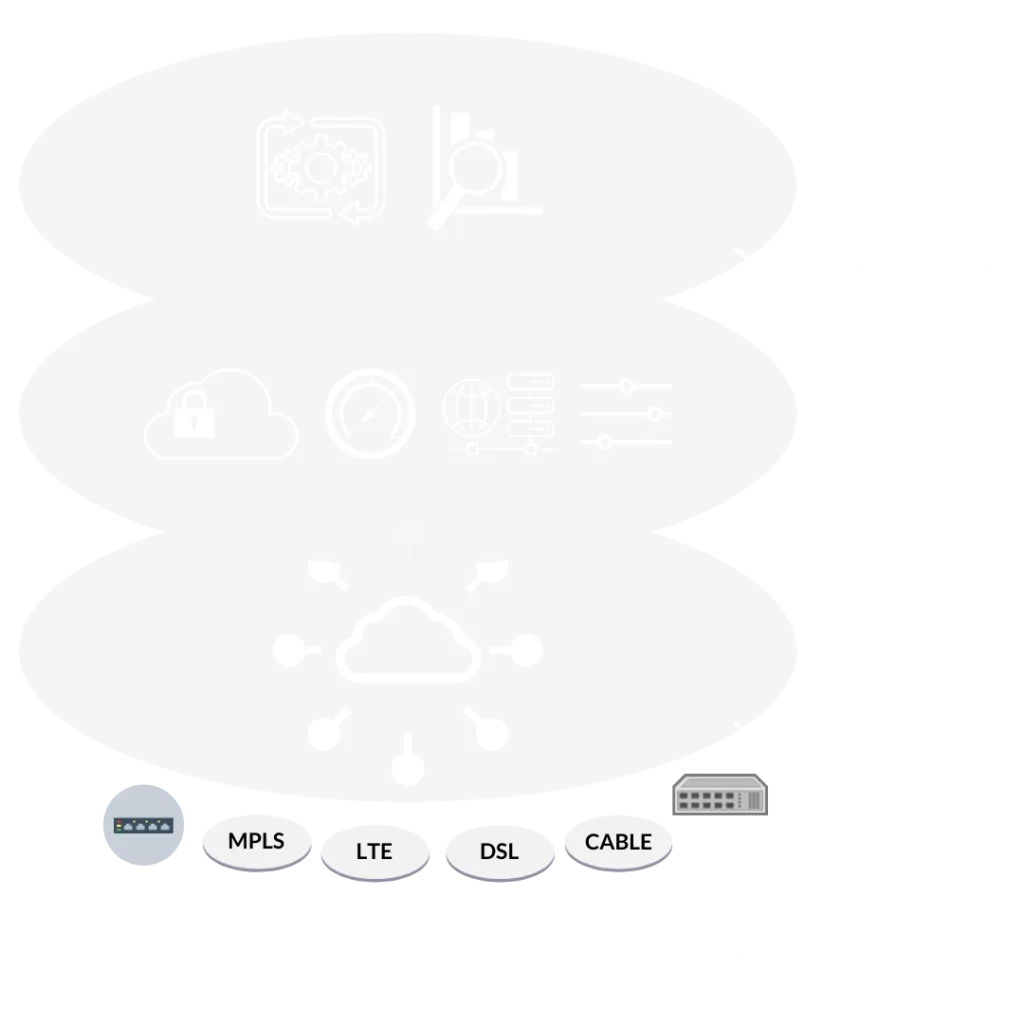
SD-WAN has three layers, from the bottom up:
- A secure cloud network
- Virtual services
- Orchestration and analysis
The secure cloud network
SD-WAN uses standard encryption such as AES to build a secure connection over links of any type, private, hybrid or dual internet, which gives you a secure cloud network.
Virtual services
Companies offer a lot of services, and those should be simple to roll out from an application catalogue. They can run in the branch, in the central data centre or in the public cloud.
Depending on the service, it can run in the central data centre. With SD-WAN those services can be provisioned over secure SD-WAN overlays on cheap branch office links, instead of over expensive private connections.
The same goes for the cloud, where branch offices should reach applications directly over the internet. Here SD-WAN decides per packet whether it goes straight to the cloud or to the central data centre. That helps performance and frees the private links from traffic that would otherwise be routed to the internet through the central data centre.
Orchestration and analysis
Software-defined networking uses a control plane separated from the data plane, so it can run on standard hardware, be more flexible and avoid being tied to one vendor. SD-WAN takes a similar approach. The orchestration layer provides the control plane: it routes network traffic to and from the nodes on site and in the cloud, offers flexibility across different transports and allows policy-based integration of distributed network services.
The orchestration layer has three functions:
- The management layer
- Dashboards for zero-touch deployment, configuration monitoring, troubleshooting and reporting, plus authentication services.
- A highly available control layer
- A mandatory component, available on-premises or from the cloud, which helps migrate from legacy WAN to SD-WAN
- The business policy framework
- Where policies are defined at business level: service availability, security and what the business requires
Deploying SD-WAN
A large share of the bandwidth on remote connections goes to cloud services such as Microsoft 365, Salesforce or other software-as-a-service offerings. That traffic reaches the internet through the central data centre for various reasons, security (scanning) and compliance (filtering and monitoring) among them. Which causes problems of its own, higher latency for one.
With SD-WAN this traffic can go straight to the cloud over the internet, without giving up control, visibility or performance.

SD-WAN offers two deployment options. Here is how traditional connections compare with the SD-WAN approach.
| Branch type | Traditional WAN | SD-WAN |
|---|---|---|
| Home office | Internet with 1 ISP | Dual internet WAN |
| Small office | Single MPLS WAN | Dual internet WAN |
| Medium office | MPLS WAN with a backup link | Hybrid WAN with one or more internet and MPLS links |
| Large office | Several MPLS links | Hybrid WAN with one or more internet and MPLS links |
Ten reasons for SD-WAN
- SD-WAN considerations
- Steering application flows automatically, to compensate for network problems such as performance and capacity.
- Flexible deployment options
- Physical, virtual, in the cloud, on-premises or even multi-tenant, all of it is open to you
- Transport-independent design
- SD-WAN supports private, hybrid and internet-only connections
- Network service integration
- Integrate network services where they are needed
- Step-by-step migration with interoperability
- Interoperability with existing devices and networks makes a gradual move to SD-WAN possible
- Scalable and redundant control and data layers
- With a single resource pool built from various network connections, the control layer is designed for high availability too
- Simpler installation, configuration and operation
- With zero-touch deployment, consolidated monitoring and visibility across applications, users, hosts, service providers and transport types, SD-WAN offers enterprise-level monitoring.
- Programmability
- A strong API lets SD-WAN fit into existing monitoring solutions
- A secure, encrypted overlay
- SD-WAN provides a secure, encrypted overlay that operates independently of the transport components
- A specialised SD-WAN solution
- A lot of vendors market their solution as SD-WAN. Only all of the points above together make a complete SD-WAN feature set.
More information?
If this interests you or you want to know more, our engineers and solution architects are here for you.